
Type 2 hair, mostly known as wavy hair, is one of the coolest hair types.
If you want to have cool and beautiful waves, you need to know what makes Type 2 hair unique.
Your hair can be in the type 2A, 2B, or 2C category; it is essential to know its type to find the best product, technique, and styling methods to uncover its natural beauty.
This guide includes everything about Type 2 hair, its characteristics, structure and care tips.
What Is Type 2 Hair?
Type 2 hair is a balance between straight and curly hair. It is famous for its natural and beautiful waves. It has a loose “S” shape. Type 2 hair can be subtle bends or heavy waves formed.
As compared to straight hair’s circular round follicle and curly hair’s flat follicle, wavy hair, Type 2, has a slightly oval-shaped follicle. So, as a result of its hair structure, Type 2 has natural “S” shaped waves. However, this in-between structure has one disadvantage: sometimes, it can be oily at the roots but dry at the ends. It is important to care for it regularly.
The most common misconception about Type 2 hair is that it doesn’t need extra care. Yet, Type 2 hair can easily be undefined, frizzy, or limp if it is improperly cared for. Besides, hair care should also be balanced: too much or too little moisturizer causes a frizzy look, or too much product makes it weigh down.
Subcategories of Type 2 Hair
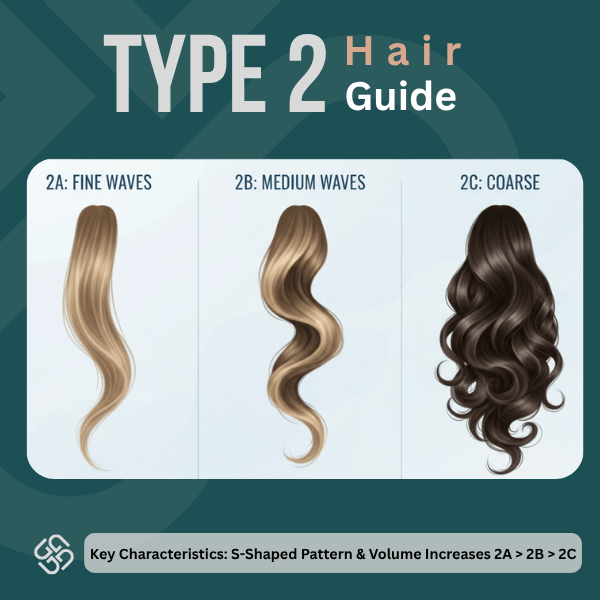
Type 2 hair has 3 different subcategories: 2A, 2B, and 2C. Each of them has their level of wave definition, thickness, and texture.

Type 2A Hair: Fine, Relaxed Waves
Characteristics of 2A Hair
Type 2A is a type of fine and smooth hair. It has soft and loose waves. Its “S” shape is close to straight hair. Therefore, Type 2A hair is easy to shape, but it can lose its volume easily, too.
- To lift the hair roots, use gentle volumizing shampoo and mousse products
- Don’t use heavy oils and creams, which make the waves straight
- Use a diffuser on a low setting or try air drying to have more visible and permanent waves
- To have beachy waves, use a salt spray
Type 2B Hair: Medium Waves with Volume
Characteristics of 2B Hair
Type 2B hair has more defined waves. These waves begin closer to the roots. 2B hair is thicker than 2A hair type. Also, it is more likely to be frizzy, especially in humid weather.
- To reduce frizz, use a moisturising but light weight conditioner
- To define the waves, prefer to use curl-enhancing creams
- After washing, use a microfiber towel or cotton T-shirt. It prevents a frizzy look
- Use sprays with heat production
Type 2C Hair: Thick, Defined Waves
Characteristics of 2C Hair
Type 2C hair is between wavy and curly hair. It has well-defined waves and thick strands with strength, which occasionally form loose curls. Type 2C is the thickest hair, but its density and frizz potential can make it difficult to care for and control.
- Do a deep care conditioning once a week to moisturise and control puffiness
- Use a wide-tooth comb on damp hair
- Don’t comb when it is dry
- Use curl creams and anti-frizz serum for wavy-to-curly hair
- To enhance its waves and definition, diffuse upside down
How to Identify Your Hair Type
You can understand what subcategory your hair falls into based on several factors below
Porosity helps measure how well a hair absorbs and keeps moisture..
Low porosity: Hair stays on the surface of water. It requires lightweight products.
Medium porosity: It keeps moisture well. Balanced hair care is essential.
High porosity: Absorbs quickly, yet it loses its moisture swiftly, too. Rich conditioners and leave-ins are required.
You need to observe your hair under the sunlight.
2A: Loose and barely invisible waves
2B: Defined but flexible waves
2C: Thick and strong waves or sometimes loose waves
You can check it by rolling a single strand between your fingers
2A: It is as thin as silk
2B: It has medium texture
2C: It is heavy and dense
A healthy hair root helps you have defined waves. If hair roots get greasy quickly, a gentle cleansing is needed. If it is dry and flaky, hydrated treatments once a week will be perfect.
Differences Between Type 2 and Other Hair Types
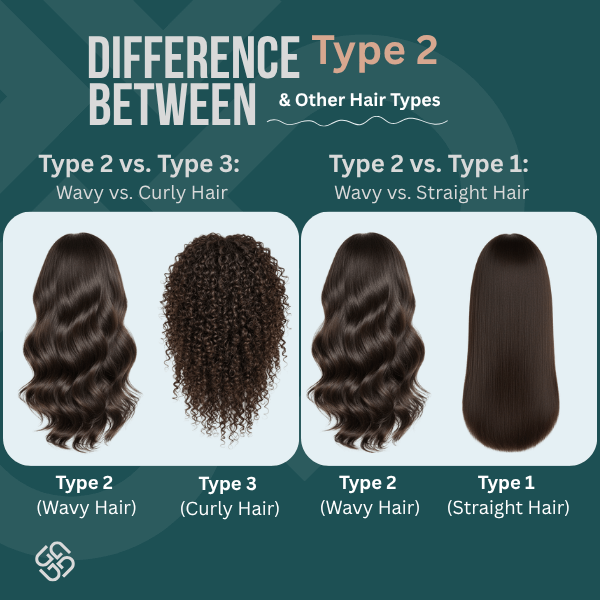
Type 2 vs. Type 3: Wavy vs. Curly Hair
While Type 2 hair has ”S”-shaped waves, Type 3 hair has spiral curls. Lighter care products are useful for wavy hair, but curly hair needs thicker creams and butters for moisturizing.
Type 2 vs. Type 1: Wavy vs. Straight Hair
Straight hair doesn’t have natural bends, which makes it flattened but shiner. Yet, Type 2 hair has more movement and texture, which makes it more frizzy and dry.
Why It’s Important to Know Your Hair Type
Understanding your hair type helps you to use the right care products and find suitable styling for your hair. So, you can save time and money in the long run.
Choosing the Right Hair Care Products
Each hair subtype requires a different care:
2A: Volumizing and lightweight
2B: Defining, also moisturising
2C: Deep hydration and frizz-control
Setting Realistic Hair Goals
You need to know that all wavy hair cannot hold tight curls or stay straight without having any damage. So, you need to buy the right hair products and apply the right care and styling options.
Understanding Common Hair Problems
The most common problems that wavy hair has are frizzy, buildup, and uneven texture. Using the wrong shampoo or conditioner makes your hair worse.
Selecting Proper Styling Methods
To have a healthy and natural hair look, you need to avoid daily heat styling. You should sleep on a silk pillowcase, which reduces the frizz. Also, you should scrunch to enhance waves.

Is Type 2 Hair Suitable for Hair Transplant?
Yes! Type 2 hair is definitely suitable for hair transplant. You can get realistic and full results after transplantation thanks to its texture and natural volume.
Type 2 hair provides great coverage even with few grafts because it has natural bends. Its wave patterns create a density to achieve natural-looking outcomes.
Type 2 hair has natural bends; therefore, it gives softness and fullness to the transplanted area. Moreover, it can easily blend with existing hair. Also, unlike straight hair, it provides more natural flow and direction.
The patients with Type 2 hair can have a healthy texture balance and exceptional coverage if they have proper surgical techniques and post-procedure care.
FAQs
Hard water, harsh shampoos and product build up cause wavy hair to lose its shape. To reset your hair, you need to use clarifying shampoo
Use a curl cream or mousse to scrunch your hair, and let it air dry. Your diffuser should be on low speed to enhance the natural pattern
Yes! Its cuticle layer isn’t flat, which is why it is more vulnerable to humidity and dryness
Hormonal changes or damage repair may cause change in texture. Yet, hair is typically stays in its genetic pattern
2 or 3 times per week will be great to avoid dryness and maintain natural oils
You should avoid products that strips moisturise such as sulfates, silicones and alcohol-based sprays
Not to ruin your waves you can use a silk pillow case or you can tie your hair in a loose pineapple.
Yes! While wavy hair needs lighter and protein-balanced conditioner, curly hair needs richer and creamier formulas